
Are horizontal equipment unsuitable for beef cattle farms? — The main differences between vertical and horizontal total mixed ration (TMR) preparation machines
Category: Company News
Release time: 2025-05-14
The main differences between vertical and horizontal total mixed ration (TMR) preparation machines The main differences between vertical and horizontal total mixed ration (TMR) preparation machines
Are horizontal equipment unsuitable for beef cattle?
The total mixed ration (TMR) preparation machine is primarily used on dairy farms, beef cattle farms, and mutton sheep farms to produce TMR. Generally, equipment is categorized into vertical and horizontal types based on the direction of the main mixing auger. Depending on the type of power source it uses, it can further be divided into stationary, towed, and self-propelled models. Currently, some livestock nutritionists and certain online livestreamers claim that horizontal TMR preparation machines are unsuitable for beef cattle farms because their overly fine and uniform mixing can easily lead to digestive and metabolic disorders in cattle, such as acidosis and diarrhea. But is this claim accurate? Let’s first take a closer look at the key differences between vertical and horizontal TMR preparation machines. And then we’ll explore whether horizontal equipment is truly appropriate—or not—for beef cattle farming.
Comparison 01. Equipment Volume
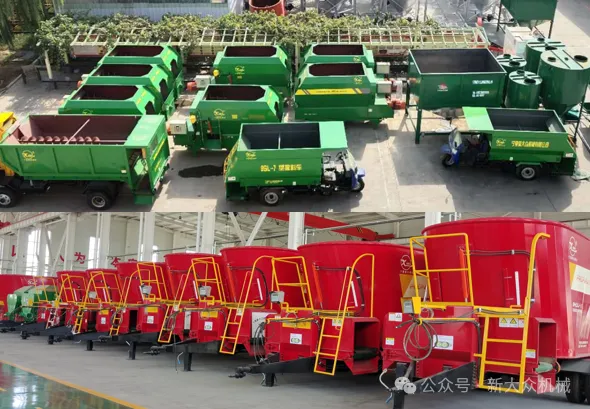
Due to limitations imposed by factors such as the length of the main agitator, blade design, and gearbox chain, horizontal equipment generally has a relatively small capacity. Currently, the market offers models ranging from 3 to 20 cubic meters; equipment with capacities exceeding 20 cubic meters is quite rare. In contrast, vertical equipment boasts a wider and more comprehensive range of models, with capacities from 5 to 60 cubic meters readily available on the market. The Xixia Sheng brand 9JGW-25S model from Ningxia Xin Dazhong Machinery Company is one of the larger fixed horizontal devices equipped with dual agitators. Xixia Sheng offers numerous horizontal equipment models, covering capacities from 5 to 25 cubic meters. Moreover, Xixia Sheng’s vertical equipment lineup is even more extensive and complete, with models available in capacities ranging from 5 to 46 cubic meters.
Comparison 02: Matching Power Unit
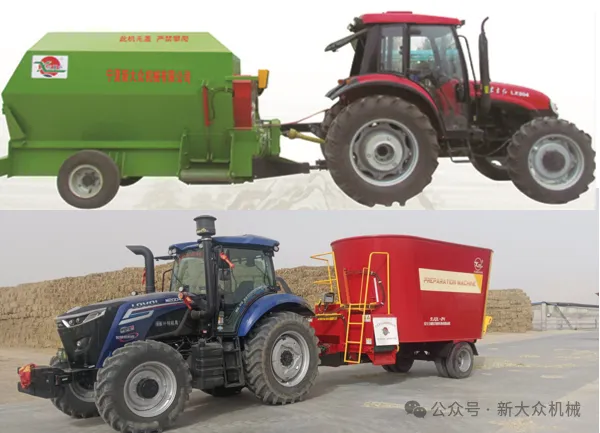
Generally, vertical preparation machines require slightly more power than their horizontal counterparts. For example, the 9JQL-12 (12-cubic-meter traction-type vertical) preparation machine from the Xixia Sheng brand is equipped with a motor ranging from 37 to 45 kilowatts, whereas the 9JQW-12 (12-cubic-meter traction-type horizontal) preparation machine is equipped with a 37-kilowatt motor. The greater the motor power, the faster the rotational speed and the mixing rate—and consequently, the faster the wear on components such as the equipment casing and the bottom of the tank.
Compare 03. Number of blades
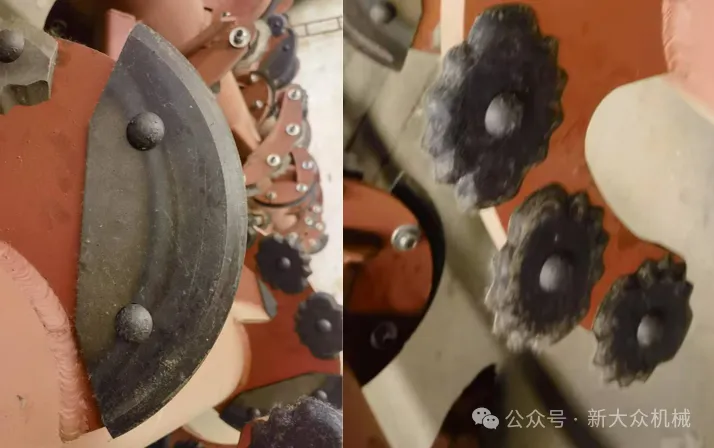
Horizontal equipment features a larger number of blades, while vertical equipment has fewer blades. The Xixia Sheng brand 9JGL-12 (12-cubic-meter fixed vertical) model is equipped with 8 large blades, whereas the 9JGW-12 (12-cubic-meter fixed horizontal) model is fitted with 64 plum-blossom blades and 36 crescent-shaped blades.
Comparison 04: Equipment Maintenance
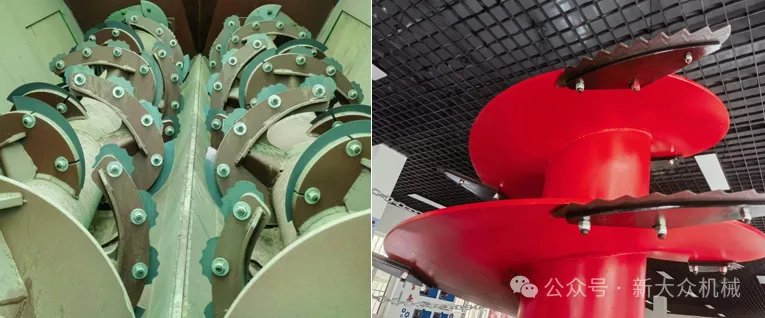
Due to the design of components such as the auger, blades, and equipment transmission chains, vertical equipment has a relatively simpler structure and is easier to maintain. However, because vertical equipment features a sealed gearbox with smaller oil-fill ports, changing the gear oil can take considerably longer. In contrast, horizontal equipment has a relatively more complex structure; when replacing blades in horizontal equipment, it’s necessary to “adjust the blades,” which is time-consuming and typically results in longer maintenance periods. Generally, replacing blades in vertical equipment takes about one work-hour, whereas replacing blades in horizontal equipment takes about three work-hours.
Comparison 05. Cutting Performance
The vertical preparation equipment can handle large or long bales of forage and boasts strong chopping capabilities. However, it performs relatively poorly when it comes to shredding and cutting blocky materials, and its ability to chop root and tuber-based feeds is somewhat limited. In contrast, the horizontal equipment excels at shredding and cutting blocky materials. While long bales tend to get tangled around the auger, this type of equipment is well-suited for cutting small bales. It’s less effective when handling large bales, but it can efficiently cut slightly moist forages such as corn stover and rice straw, as well as root and tuber-based feeds.
Comparison of 06. Discharge Methods
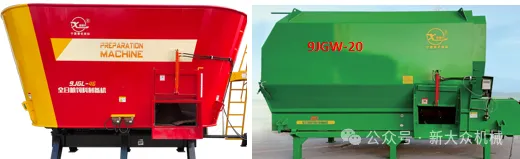
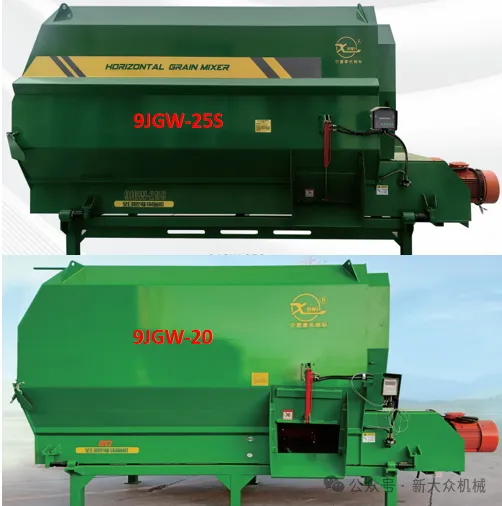
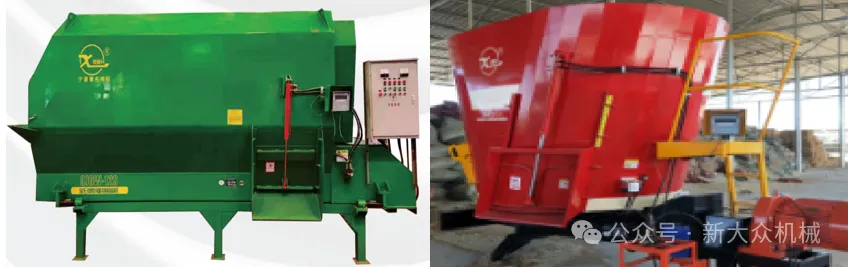
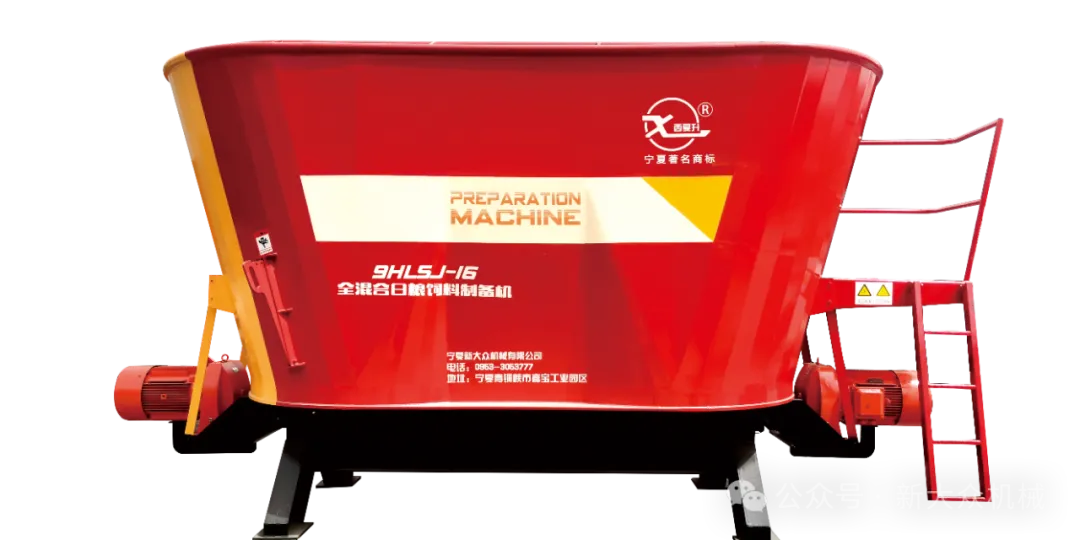
Some vertical equipment is equipped with fabricators and features either dual-side discharge ports or single-side discharge ports. Horizontal equipment has only one discharge port. The primary卸料 methods for vertical equipment include scraper or sliding mechanisms, while horizontal equipment typically uses belt or sliding mechanisms. The illustration shows two models: the Xixia Sheng brand fixed vertical equipment with a capacity of 46 cubic meters and fixed horizontal equipment with a capacity of 20 cubic meters.
Comparison of 07. Rubbing Performance
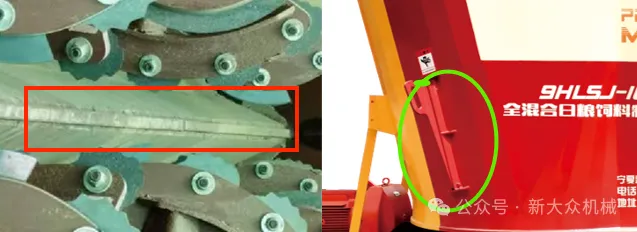
In horizontal equipment, the fixed blades are very long, and the gap between the blades and the side walls is minimal, giving it a kneading function. As a result, the TMR produced has a smooth, non-abrasive texture. In contrast, the fixed blades in vertical equipment are much shorter; their primary function is to increase resistance and accelerate the cutting action of forage or feed particles, thereby reducing the length of the forage and other feed materials. Because of this, the kneading effect is weaker, and the TMR produced tends to feel slightly abrasive.
Comparison of 08. Equipment Height
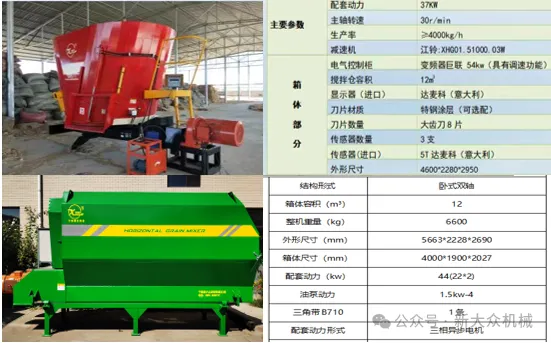
Horizontal equipment has a lower height, with the feeding port located at the rear, allowing for manual feeding. Vertical equipment, on the other hand, is taller and features a feeding port at the top, requiring auxiliary feeding equipment such as loaders or conveyor belts. Some fixed vertical equipment is even designed and installed underground, employing manual feeding methods. The West Xia Sheng brand horizontal equipment model 9JGW-12S has an overall height of 2,690 mm, while the vertical equipment model 9JGL-12 stands at 2,950 mm. Thus, the horizontal equipment is 260 mm lower than the vertical equipment.
Compare 09. Mixing Volume
For vertical equipment, the feed mixing capacity can reach up to 90%. For the 9JGL-12 model, the maximum volume can be as high as 12 × 0.9 = 10.8 cubic meters. Based on a TMR density of 330 kg/cubic meter, this translates to a bulk weight of 3.56 tons. For horizontal equipment, the capacity is 85%; for the 9JGW-12 model, the maximum volume can reach 12 × 0.85 = 10.2 cubic meters. Again, based on a TMR density of 330 kg/cubic meter, this corresponds to a bulk weight of 3.37 tons. The minimum mixing capacity for vertical equipment must not fall below 50%, while for horizontal equipment, the minimum capacity must not be less than 30%.
Comparison 10: Stirring and Mixing Uniformity

The mixing uniformity of vertical equipment is slightly lower compared to horizontal equipment. For Xixia Sheng brand 12-liter fixed vertical equipment, the single-cycle mixing time typically stays below 37 minutes, and the mixing uniformity can reach 93% to 98%. For horizontal equipment, the single-cycle mixing time is under 45 minutes, and the mixing uniformity can reach 95% to 98%. Vertical mixers operate at a faster speed; the main screw rotates at 22 to 32 revolutions per minute, whereas horizontal mixers are slower, with the main screw rotating at 16 to 26 revolutions per minute.
Conclusion: For a beef cattle farm, should you choose horizontal or vertical housing?
In summary, based on the 10 aspects of differences and characteristics listed above, both vertical and horizontal equipment have their own advantages and disadvantages, each with distinct features. Some ranches prefer horizontal equipment for chopping corn stover or straw, while others favor vertical equipment because it mixes materials thoroughly without causing tangling or clumping, resulting in a highly uniform blend. Vertical equipment is widely favored by most ranches due to its simple design, ease of maintenance, and fast processing speed. It would clearly be somewhat biased and one-sided to conclude that beef cattle ranches cannot use horizontal equipment simply because they tend to overmix and produce excessively fine feed. If all ingredients are added first and then mixed for just five minutes before discharge, this issue of over-mixing can be completely avoided. What’s more, we should pay close attention to avoiding problems such as excessively long mixing times or delays in discharging the finished mix after mixing is complete. Currently, vertical equipment accounts for about 70% of total sales in the market, while horizontal equipment makes up roughly 30%. When choosing between these two types of equipment, it’s crucial to take into account not only the equipment’s performance characteristics but also the specific properties of local forage and feed available on the farm. Only by tailoring the selection to the local conditions can ranchers make the most informed decision. So, which type of equipment—vertical or horizontal—is better suited for beef cattle farms and dairy farms? You know best! Feel free to share your thoughts and leave a comment—we’d love to hear from you!
Welcome to call the consultation hotline of Ningxia Xindazhong Machinery Co., Ltd.: 0953-3053777
Keywords: Are horizontal equipment unsuitable for beef cattle farms? — The main differences between vertical and horizontal total mixed ration (TMR) preparation machines
Relevant Information

“Exquisite fireworks bloom across the continent, and boundless scenery opens up before the poet’s eyes.
Contact Us
WhatsApp:
Address:
Jiabao Industrial Park, Qingtongxia, Ningxia, china
Email:
William Guo


