
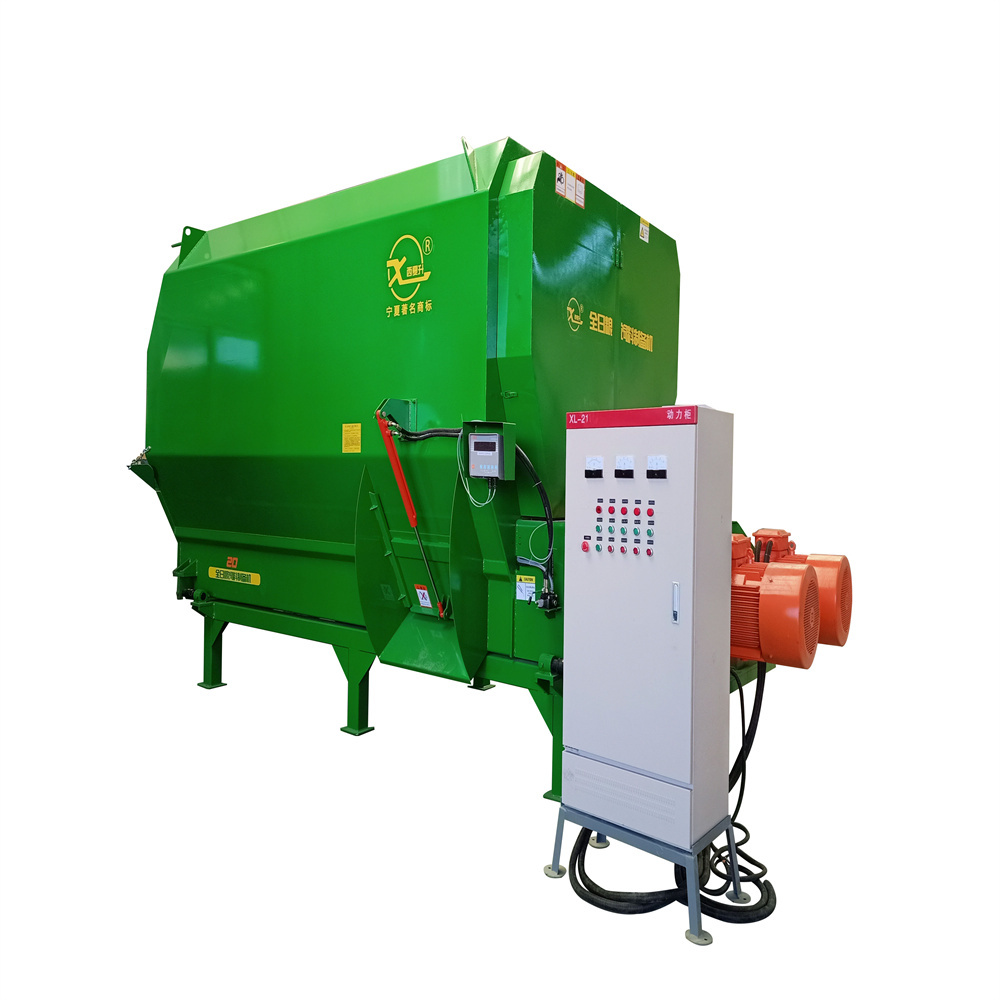


Complete Feed Preparation Machine – Dual-Axis 9JGW-20S
Category: Other Products
Email:
Product Introduction
Technical specifications:
Model |
Structural Type |
Matching Power (kW) |
Auger rotational speed (r/min) |
Mixing bin volume (m³) |
Mixing bin body dimensions (mm) |
Overall dimensions (mm) |
9JGW-7S |
Horizontal/Fixed |
18.5x2 |
18 |
7 |
2800*1700*1950 |
4328*1928*2670 |
9JGW-9S |
Horizontal/Fixed |
18.5×2 |
18 |
9 |
3100*1800*2050 |
4553*2093*2676 |
9JGW-12S |
Horizontal/Fixed |
22x2 |
20 |
12 |
4000*1900*2030 |
5663*2228*2674 |
9JGW-16S |
Horizontal/Fixed |
30x2 |
20 |
16 |
4000*2200*2250 |
5687*2378*2890 |
9JGW-20S |
Horizontal/Fixed |
37x2 |
20 |
20 |
4000*2400*2510 |
5740*2687*3130 |
9JGW-25S |
Horizontal/Fixed |
37x2 |
20 |
25 |
4528*2600*2610 |
6230*3038*3242 |
Product Introduction:
This product features an internal structure consisting of two independently driven main spindles powered by gear reducers, along with two counter-rotating helical auger shafts. It is suitable for large, medium, and small-scale dairy farms and livestock operations, enabling rapid chopping and highly efficient mixing of silage, hay, and concentrated feed—particularly well-suited for the chopping and blending of roughage.
Product Features:
The machine housing is made of high-quality, wear-resistant materials and employs advanced welding techniques both domestically and internationally. It is equipped with a well-known domestic brand reducer and high-grade cutting tools, ensuring exceptional wear resistance, sharpness, and long service life. Depending on the customer’s specific feeding requirements, either domestic or imported load cells can be optionally installed. This machine offers rapid chopping and mixing, high uniformity, and high efficiency, while also reducing raw material waste, optimizing feed nutrition, lowering labor intensity, and providing a long service life.
Maintenance of Horizontal Total Mixed Ration Feed Preparation Machine
I. Reducer Maintenance:
After the new machine has been in operation for three months, the reducer gear oil should be replaced; thereafter, the gear oil should be changed every six months. (It is recommended that customers replace the winter-grade L-CKD220 gear oil in October each year and the summer-grade L-CKD320 gear oil in April.) Regularly check the oil level to prevent abnormal wear of components.
Gear Oil Fill Quantity for the Reducer of a Horizontal Feed Mixer
15 kW reducer, 18 kg, 22 liters
18.5 kW reducer, 18 kg, 22 liters
22 kW reducer, 25 kg, 30 liters
30 kW reducer, 25 kg, 30 liters
37 kW reducer, 50 kg, 59 liters
II. Inspect the blade:
Inspect the wear condition of the moving knives on the mixing auger shaft. If the knife blades become dull, they must be immediately flipped or replaced (the original blades have double-sided cutting edges and can be flipped for use on either side). Under normal operating conditions, single-shaft feed mixers require blade flipping or replacement every 300 hours of operation, while dual-shaft feed mixers require such maintenance every 200 hours. Note: When the knife blades are worn, the material is mixed primarily by the knife arms, which accelerates arm wear and increases the load on the main shaft, potentially leading to motor burnout, gear damage in the reducer, or breakage of the main shaft end.
III. Bearing Lubrication:
Lubricating grease shall be replenished in the spindle bearing housing every two weeks. Note: The bearing oil passages are very narrow; if lubrication is neglected for an extended period, the oil within the passages will dry out, making it impossible to inject lubricant thereafter.
IV. Hydraulic System Maintenance:
Regularly inspect hose fittings and fasteners for looseness to prevent leaks and disconnection. Replace approximately 6 liters of L-HV46 low-temperature anti-wear hydraulic oil annually. (In winter, conventional hydraulic oil is prone to freezing, which can cause the pump to fail.)
V. Special Notes:
Before starting work, briefly activate the switch to verify that the mixing shaft rotates in the direction indicated by the label. If the rotation direction does not match the label, reverse the connection sequence of the main power supply lines. Then, start the feed mixer and run it under no-load for 2–3 minutes; only proceed with feeding once you have confirmed that all equipment is operating normally. (If the spindle rotates in the opposite direction, it may seize up, potentially causing the helical blades to topple over or the spindle to become misaligned. A toppled spindle will prevent forward material delivery, while spindle misalignment can lead to chain disengagement and damage. Special attention must be paid: after a power outage, always verify that the rotation direction is correct before resuming operation and feeding.)
Keywords: Complete Feed Preparation Machine – Dual-Axis 9JGW-20S
Related Products
Product Inquiry
You can contact us through any convenient means, and we provide services 24/7 via phone or email. We are happy to answer your questions
Contact Us
WhatsApp:
Address:
Jiabao Industrial Park, Qingtongxia, Ningxia, china
Email:

William Guo


