
Product Features
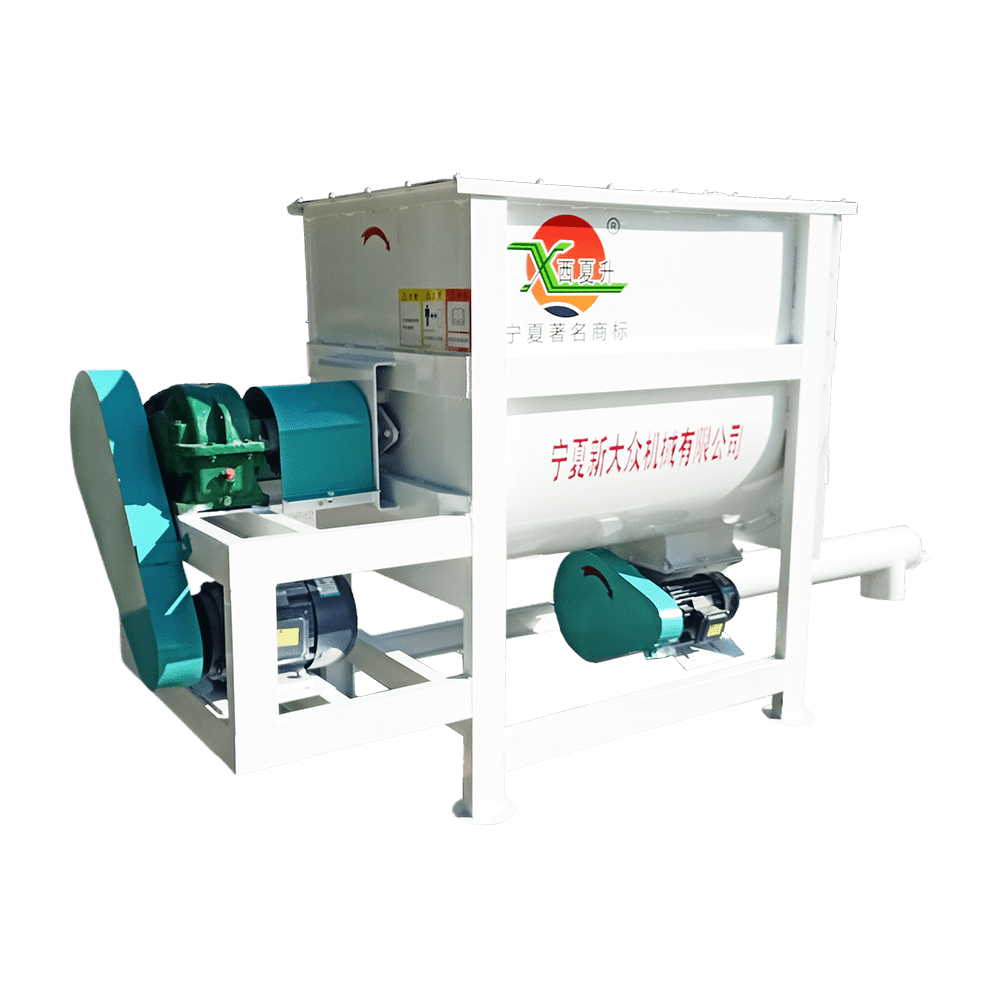


9HWP-1000 Horizontal Feed Mixer
Category: Horizontal TMR Mixers
Runs smoothly without damaging the original properties of the material.
Email:
Product Introduction
This product is suitable for applications such as pasture management, feed processing, and aquaculture. It can handle various liquids and operates smoothly without compromising the original properties of the materials. It consumes little power and boasts high energy efficiency. Optional weighing sensors are available, ensuring excellent mixing performance, high efficiency, uniformity, minimal dust generation, and reduced residual material after discharge—thus helping to cut labor costs.
Technical Parameters
Model | Matching power (kW) | External dimensions (mm) | Structural form | Production (tons/batch) | Mixing Uniformity (%) |
9HWP-500 | 5.5 | 2194×949×1444 | Horizontal | 0.5 | ≥95% |
9HWP-1000 | 7.5 | 3408*1228*2484 | Horizontal | 1 | ≥95% |
9HWP-2000 | 15 | 3100X1300X2500 | Horizontal | 2 | ≥95% |
Feed Mixer Maintenance and Servicing
1. Before starting work, briefly activate the switch and check whether the rotation direction of the agitator shaft matches the direction indicated by the label. If the rotation direction does not match the label, swap the connection sequence of the power supply wires. Then, start the mixer and run it under no-load conditions for 2–3 minutes to ensure that all equipment functions properly before beginning actual work. (If the main shaft rotates in the opposite direction, the feed shaft may become jammed, potentially causing the helical blades to collapse. Once the helical blades collapse, the main shaft will no longer be able to feed material upward. Pay special attention to confirming that the rotation direction is correct before restarting the machine after a power outage.)
2. The area around the mixer must be kept free of clutter and debris; any dirt or debris should be thoroughly cleaned away. Particularly for mixers equipped with weighing systems, if other objects are leaning against the mixer or if there is debris beneath the mixer’s support legs near the load cells, this could lead to inaccurate weight readings. Also, check that all fastening nuts are securely tightened and that the V-belt and pulleys are in good condition. If the machine is installed outdoors, the top of the motor must be covered with a plastic sheet to prevent rainwater from entering—but make sure the motor’s ventilation holes remain unobstructed.
3. After accumulating 100 hours of operation, lubricate the bearing area once with lithium-based grease. Each time you apply grease, make sure oil can be seen oozing out from the gap between the bearing housing and the main shaft. This ensures two things: first, that the grease has been properly injected; second, that the fresh, clean grease displaces and expels the old, contaminated grease.
4. The volume of the mixer’s mixing chamber is always expressed in cubic meters. When people verbally refer to a mixer’s capacity in tons, they’re only giving a rough estimate of its weight—after all, different feed formulations have different specific gravities. Generally, when feeding ingredients into the mixer, there should be a 30- to 40-centimeter clearance left inside the mixing chamber to allow for proper mixing operation. If the chamber is filled too full, the available mixing space will become too small, increasing the load on the main shaft and potentially leading to issues such as the spiral blades being knocked over, the main shaft breaking, or the motor burning out.
Keywords: 9HWP-1000 Horizontal Feed Mixer
Prev: Nothing!
Related Products
Product Inquiry
You can contact us through any convenient means, and we provide services 24/7 via phone or email. We are happy to answer your questions
Contact Us
WhatsApp:
Address:
Jiabao Industrial Park, Qingtongxia, Ningxia, china
Email:

William Guo


